Featured Member: Dr. Dirk Schlottmann

What kind of photography do you do?

I like on one hand, images that reflect the mood of a situation and thereby have an illustrative character that goes beyond the actual situation and on the other hand I am fond of photographs, that reflect the essence of a person or situation. Thematically, I’m interested in the “between” or, as the famous anthropologist Victor Turner’s once said the “Betwixt and Between”.  So my topics are ritual, religion, culture …. ethnological topics.

© Dr. Dirk Schlottmann

Story behind the image: The man in the wheelchair and the little island are a intense metaphor.

How would you describe your style?

I am an visual anthropologist. So I would describe my style as a mixture of docu and art.

© Dr. Dirk Schlottmann

Story behind the image: The photo “seagypsy girl” is a sweet, charming portrait I took at Sulawesi.

What or who inspires you?

I like the korean docu-photographer Kim, Soo nam, the portraits of Eric Lafforgue, some works of Michael Ackermann, the incredible work of James Nachtwey and many others.

© Dr. Dirk Schlottmann

Story behind the image: I like the photo of the naga baba because it has special lighting conditions, which give the perfect setting to the Naga Baba and his spirituality. It reminds me of a fantastic time at the Kumbh Mela in India.

What gear do you use?

I shoot with a Nikon D700. Therefore I use different fixed focal lengths: 20mm, 24mm, 35mm, 50mm and 105mm. I do not work with a zoom. Usually I opt for a lens and then I try to capture the subject with this focal length. When I am done I might  change to a different focal length.

-

Links

Website: www.photoanthropos.com , http://www.mabellephoto.com/photographe-dirk-schlottmann-g10101.htm

Featured Member: Daniel John Bilsborough

What kind of photography do you do?

Travel photography and wedding photography.

© Daniel John Bilsborough

Story behind this image: This was taken at the Ngorongoro Crater in Tanzania, it was early in the morning and I was standing on the seat of a soft top 4wd safari vehicle with half of my body out of the car. We drove up to this guy while he was standing in the middle of the road and after he bluffed a charge at us he moved into the flowers and we drove past taking photographs. Love.

How would you describe your style?

I dont really know how to describe my style, but my aim is just to show the world as it is. I draw a strict line between photography and digital art. It’s very easy to manipulate a photograph to the point where’s it can no longer be considered a photograph. I stay well away from that line.

© Daniel John Bilsborough

Story behind this image: I was snowboarding at one of the most beautiful places on earth, Bariloche Argentina. The view from the top of Cerro Catedral is indescribable, this is just a taste.

What’s your approach to post processing?

I use Adobe Lightroom for “development” work like colour correction, strengthening composition and usually straightening the horizon – that seems to be one thing my brain cannot cope with through the viewfinder!

© Daniel John Bilsborough

Story behind this image: I just LOVE blending landscapes into my wedding photography work. I had a perfect opportunity at Yarra Valley right here in Victoria Australia. This is Kara and James.

What or who inspires you?

Jasmine Star for the way she brings out natural expression in her subjects. And Jonas Peterson for his artistic style and ability to blend landscape and travel photography into his wedding work.

What gear do you use?

Nikon D700, 85mm F1.4, 50mm F1.4, 35mm F2.0 and 20mm F2.8. Oh and at wedding ceremonies I use my trusty 70-200mm F2.8. All Nikon Glass.

-

Links

Website: www.djbworldphotography.com
Facebook: http://www.facebook.com/djbworldphotography
Twitter: http://twitter.com/djbworldphoto

Featured Member: Debesh Sharma

What kind of photography do you do?

As a self-described amateur photographer, writer, traveler and wanderer, it would only be fair to say that the genre which really arouses my senses and sensibilities is travel photography. I am intrigued and inspired by landscapes and architecture in their changing forms, but what I’m most passionate about is creating portraits of “ordinary, everyday” people I meet along my journeys, all of whom have a different story to tell, which I then attempt to narrate through my images.

featured-member-debesh-sharma-04

© Debesh Sharma

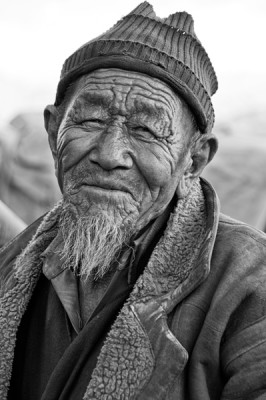
Story behind this image: I made this photograph of an old man while in Ladakh, India. While heading back to where I was staying, I saw him sitting in a junkyard by the side of the road, leisurely puffing away on his cigarette, in the light of the setting sun. I was tired at the end of the day, and went past him by a mile or thereabouts. But then I couldn’t hold resist myself and the voice inside of me. I turned around and headed back to him. He was shy and reticent, and unwilling to get his photographs made. I offered him a smoke, and from then on, everything was just fine as he became my muse-for-the-day. Ever wondered how the twinkle and the mischief in the eyes can be seen on the face without even the eyes being visible?

How would you describe your style?

Photographers, as in any other creative, literary or artistic pursuit have a signature style, and to be completely honest, I am figuring mine out. From simply saying “I was here”, I now want my photographs to say “I felt this”. And since I’m still on this path of discovery, I photograph all genres, though of late, as I just said, I have been focusing more on travel photography and portraits of “ordinary, everyday” people. I am developing a feel for monochromes, which I believe are more expressive than color photographs at times.

If I were to answer this question, however, in a few words, I’d rephrase Descartes and say, “I photograph, therefore I am”.

featured-member-debesh-sharma-05

© Debesh Sharma

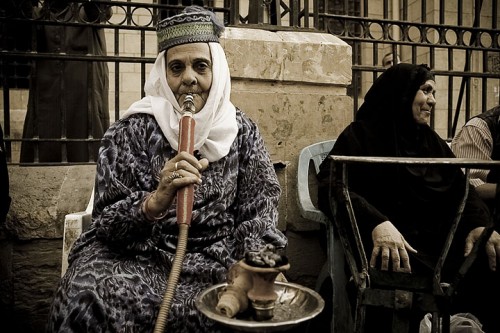
Story behind this image: This image of an old lady was made by me en route to Matho Gompa in Ladakh. She couldn’t speak either English or Hindi and so I told my driver to talk with her in the local language and request her permission for me to capture her grace. She reluctantly said yes, but only on the condition that I send her the photographs which I did. Quite a bargain that was! She didn’t smile – not once in the half-an-hour that I spent with her. Just this vacant, faraway stare. I had always believed that it’s only the eyes which can reflect a story within, but as with the old man and her yet again, the face and its lines do as well. With her (and in her photographs), I could sense hardship and pain, and yet undisguised dignity.

What’s your approach to post processing?

I am a purist at heart. I rarely if ever crop my images, and when I do, it’ll either be a square or a 9:16 crop. I shoot in RAW and process in Photoshop which I limit to adjustments in Camera RAW and then a conversion to JPEG, at times using Nik Color Efex. For my B&W images, I use Nik Silver Efex. As my post processing is minimal, a single image is usually done within maybe 5 or 10 minutes. I agree that if I spend more time on my images in the digital darkroom, they’d surely be better, but then someone needs to teach me patience along with Photoshop!

featured-member-debesh-sharma-06

© Debesh Sharma

Story behind this image: This is a photograph of a traditional mithai-wallah (sweets-seller) at Amritsar, India, in small lane near the Golden Temple. I went up to him to make a few photographs, and he most readily agreed. I was mesmerized with the joie-de-vivre in his eyes, and of course the one-tooth smile, the three-day stubble, errant tufts of hair, awry eyebrows, all of which made for this most endearing image of an old man indulging my passion for photography.

The indomitable quality of the human spirit, courage in the face of adversity, the inner strength we all possess but fail to recognize, never ceases to amaze me. It gives me hope, it inspires me – which is why I look for “ordinary” people to frame and which is why I see these images over, and yet over again.

What or who inspires you?

Many years ago, I read the book, “Bridges of Madison County” about a National Geographic photographer who finds love while on assignment in Madison County to create a photographic essay on the bridges in the area. Of course that never happened to me, but it did fuel an incurable romantic’s passion for photography.

Many inspire me, but two names come to mind always without fail. Steve McCurry for his evocative, emotional, expressive photography, especially portraits; and David duChemin for not only his photography, but also his writing. “Within the Frame”, written by him, allowed me to walk this path with greater feeling and depth, and to write a photo blog where I could express my feelings as I stumbled along, to many others such as me. My writing also inspires me as it is my openness to share this journey with you, my trials and tribulations both, my angst and happiness in equal measure, so that you can see the world through my heart but as it appears through my lens. I am a voyeur as a photographer but also an exhibitionist because I am unabashedly naked with my feelings in my photographs and words, and what I have to say.

What gear do you use?

Nikon D90 and Nikkor lenses and speedlights, though most of my images have been made using my trusted friend – the Nikkor 18-200 mm f/3.5-5.6 zoom. As David duChemin said: “Gear is good, vision is better”.

Links

Cairo Report: Zekr, or Soccer?

tewfic_zekr_sheesha

On my way to Cairo I developed a plan to photograph and document the zekr; a form of ritual performed by Sufis, a sect of Islam frequently considered as too liberal and too progressive by the more orthodox theological authorities in Egypt and the Islamic world. It was a tall order since I was after the authentic zekr, not some version diluted or prettified for the tourists and tour groups. It was therefore by pure luck that I discovered someone with strong connections to one of the Sufi tariqahs or sub-sects, and who promised me full access to a number of these rituals. The devotions of many Sufis center on the zekr, a ceremony at which music, body movements, and chants induce a state of ecstatic trance in the disciples. [Read more...]

A Quick Introduction to Mono Lake

Stormy Sunrise at South Tufa

Stormy Sunrise at South Tufa

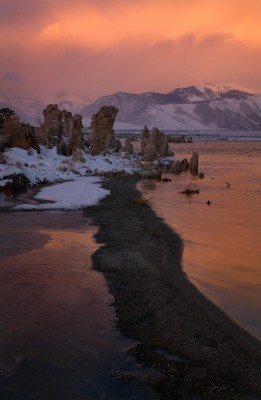
Mono Lake is one of the most famous California nature photography sites, that fame is a consequence of both it’s photographic and environmental history. Environmentally it supports the second largest population of California gulls (the first, paradoxically, being in Utah), that support was threatened by the diversion of streams that provide water to the late for use by the Los Angeles Department of Water and Power, 300 miles away. Photographically, tufa, the strange limestone formations exposed by the lowering lake level, the backdrop of the Sierra Nevada to the west, and the gull population provide a rich source of photographic opportunities.  In this post, I hope to excite you (just a little bit) about the area, and suggest a few places you might want to begin your photographic exploration of the area.

The most frequented area of the lake is the “South Tufa Area”, located along the south side of the lake.  While often a busy and well-frequented area, the number, size and variety of the tufa formations there are  unparalleled.  Your biggest challenge many times of year will be other photographers, but the area is large and gets interesting light both at sunrise (both toward the Sun and toward the Sierra) and just past suns, when the geography and elevation often provide strong, saturated earth shadows such as the one in the image I’ve included above. [Read more...]

Are You Doing Audio Slideshows Yet?

tewfic_bahadur_multimedia
I’m a fervent believer, a virtual “evangelist” if you will, in combining multimedia along with still photography. I can only speak to travel and documentary photography, but multimedia obviously lends itself to all visual disciplines such as wedding, landscape and other photography styles and directions.

I teach emerging photographers and photojournalists classes that shows them how to make quick work of slide show production, using their own images and audio generated in the field, to produce a cogent photo story under the simulation of publishing deadlines. Most of the class time is spent photographing in the field, while indoors time is devoted to weaving the material into photo stories, and the storytelling; the core of all multimedia productions. I will be teaching such a class at the Foundry Photojournalism Workshop in the Himalayan foothills of India in July 2009. [Read more...]

Fixers, Field Recorders & the iTouch

Having been photographing Theyyams, the religious rituals indigenous to Northern Kerala in India a couple of weeks ago, I thought it’d be timely to share my approach when I photograph such public (and possibly sensitive) events such as those I witnessed.

The most important tip is a no-brainer. Employ the best fixer you can find and afford. I’m not talking of tourist guides who trawl tourists in their wake, but of fixers who are adept in solving problems, who can get you to where you need to be in less time with less hassle than you can on your own, and who have the requisite connections. Good fixers are not easy to find, and must develop a personal connection with the photographer. If you don’t like your fixer, chances are that he or she won’t do a good job. [Read more...]

Scouting the Oregon Workshop

(This is the first of a series of posts I’ll be making from the road during a workshop I’m giving along the Southern Oregon coast. It’s my hope that this series will be of interest both to photographers looking to take workshops in the future, as well as photographers giving workshops.)

For me, one of the most important parts of giving a photo workshop is the scouting, spending (depending on the workshop) one or more days scouting. [Read more...]

I Have a Little List….

It’s time to pack!

In two days I leave to begin scouting for my upcoming photo workshop in Oregon, today I’ll start some of the necessary packing for the trip. It sure seems like there’s a lot of stuff to remember to bring, as much as I’ve appreciated a digital workflow, there’s just a lot more stuff to bring along. This used to drive me crazy, because I could never shake the idea that I’d forget to bring something, even when I hadn’t forgotten anything. Eventually, I just made a list, and then refined it over time. My standard list contains some things that won’t be necessary for every trip, that’s fine, it’s very easy to cross out things that you decide not to pack. [Read more...]

Ten Travel Photography Commandments

tewfic_sadhu_varanasi

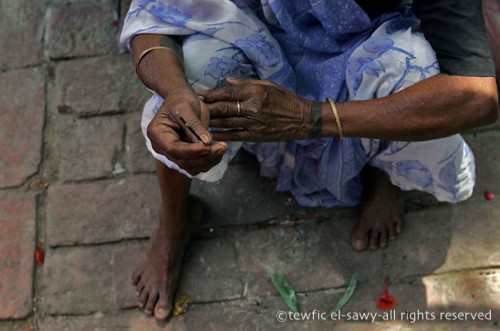
Photo ©Tewfic El-Sawy-All Rights Reserved

I’m soon to travel on a photo-expedition to the south of India with the intention of documenting the unusual ritualistic dances called Theyyam. The dances take place in remote villages principally in the state of Kerala, in a region known for its several thousand-year-old traditions, rituals and customs.

I thought I’d start my inaugural post by sharing my ten travel photography commandments, distilling what I’ve learned over the course of the past years as to what helps make better travel and environmental (on-location) portraits…or at least, what works for me. [Read more...]