
How to Sell Prints Online with WordPress
How to Sell Prints Online using WordPress’s most popular gallery plugin, NextGEN Gallery.
How to Sell Prints Online using WordPress’s most popular gallery plugin, NextGEN Gallery.

Being in the photography industry, we take for granted how easy it is to put together a wall art collection or an album. We forget that these sorts of things can be totally overwhelming for our clients. They have every intention of sitting down to choose their wall art and album images, but the sheer number of images they have to sort through overwhelms them, they don’t know how to choose the best image groupings, etc.

There are so many methods for increasing photo sales in your business. Today we want to just share a few of those. Sometimes the simplest ones are the ones most…

There are many good reasons for still photographers to also create videos for clients. But does that harm videographers? Watch the video, then you be the judge! https://www.youtube.com/watch?v=y0SBKx0IWeE

Our friends at Preveal acquired an amazing sales product called Salesographer, and they just relaunched it with a new lower price. Salesographer is a pricing and profit-boosting sales strategy for…
Selling prints is never an easy task. Tools like Preveal and the Photocrati eCommerce system make it easier. But selling doesn't end there. Today I am happy to share YouProof,…
As we move towards the coming new year many of us are beginning to implement a new marketing plan. Also, as the holiday season comes to a close many of our thoughts are on giving. Cause marketing is an opportunity to combine the two. For those unfamiliar with the term, cause marketing is a form of marketing that allows two organizations, one for profit, and one non-profit, to work together to further each of their individual marketing/development goals in a cooperative fashion. Think of the (product) RED campaign, or the partnership between the NFL and United Way.
Cause marketing can be as simple as offering a sponsorship to a local charity event, or as involved and complex as you care to make it. Below are some examples of actual cause marketing campaigns I’ve seen photographers in my market employ”¦
Even in this world of online meetings, websites and blogs we need a printed portfolio book to show prospects. I’m in the process of re-doing my books so I’ve been researching this pretty heavily.

The format and styling of your book will depend greatly on who you’re marketing to as well as your own personal style. A wedding book is not going to be anything like a commercial book which won’t necessarily look like a pj book. In general here are a few nuggets of wisdom I’ve been able to scrounge in my research. (more…)
Tell the World You Don’t Suck: Modern Marketing for Commercial Photographers by Leslie Burns Dell’Acqua
I’m a big fan of marketing and advertising my business. I really try hard to put my work, my business and my name out there as much as possible. With that said, sometimes I get stuck. Getting stuck in your marketing is no different from getting stuck creatively. It happens to all of us and learning how to break out of that rut and into more productive areas is important for any business owner. It’s at times like these that books like this one come in very handy indeed. Sometimes we need a creative kick in the pants, sometimes the foot is more business oriented. (more…)
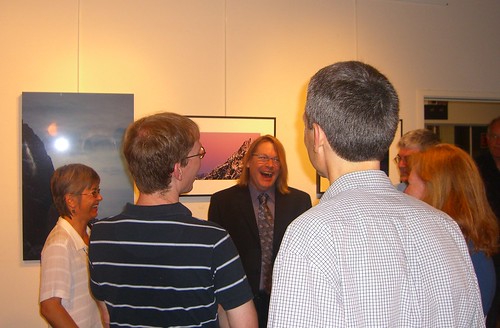
My two-person show “Rhythms” opened last night in San Jose, and the reception was a blast. It can be a challenge to get the most out of a show of your photography, I’m often astounded by how many artists believe that their work will “sell itself”, but nothing could be farther from the truth. Here are a few tips for getting the most out of your photo exhibitions.
1. Make sure your pricing makes sense. Most venues will want about half of the gross of any sales of your work, which means that your half has to cover printing, matting, framing, labels, and oh, you wanted to make a profit, too, right? One of the biggest mistakes I see artists make is underpricing their work. If you don’t make it clear that to folks that your work is valuable, why should they believe otherwise? (more…)