Canon EOS 7D Digital SLR Review: Field Test Report
Posted on February 8th, 2010 by Jack Neubart | 16 Comments
Jack Neubart discovers that this 18 MP single-digit “D” series APS-C EOS camera is indeed a chip off the old block—and then some.

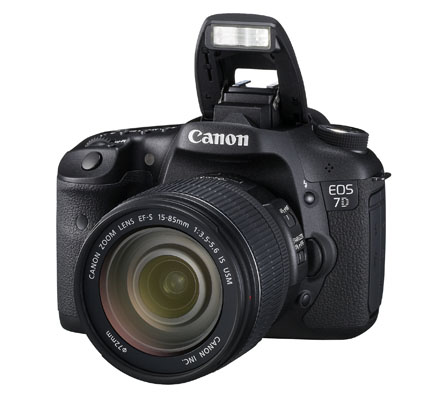
Canon EOS 7D—front. The 7D is shown here with built-in flash ready for action, with EF-S 15-85mm lens attached. I hadn’t worked with this lens, but the camera itself should be a model for future EOS designs. Canon photo.
I was all set to begin this review with a diatribe about all the negatives pertaining to movie shooting and Live View, but then thought better of it and opted to take the journey into 7D-dom with a positive foot forward.
When you look at the real meat and potatoes inside this machine, you’ll discover, as I did, that when you peel back the movie capture veneer, the Canon EOS 7D is a very capable DSLR. That’s especially true when it comes to capturing breaking action, owing to a highly responsive, albeit not flawless, AF system coupled with an even more responsive shutter release. There—I took the high road. Too bad Bob Hope isn’t around to do the movie version: “The 7D Road to Bali, the Musical.” I could even write the music and lyrics. Read the rest of this entry »
Nikon 70-200mm f/2.8G AF-S ED VR II Lens Review: Field Test Report
Posted on February 7th, 2010 by Peter K. Burian | 3 Comments
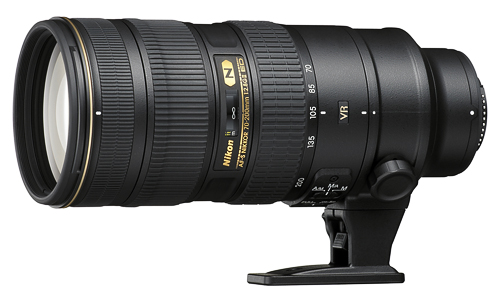
Peter Burian tests this improved lens, one of the very best available in the “fast” telephoto zoom category

The preferred “workhorse” among many professional photographers since 2003, Nikon’s AF-S 70-200mm f/2.8G ED VR model was also my favorite lens in the Nikkor series. It was just about perfect in all aspects, except for some slight corner softness at wide apertures with a full-frame digital SLR. Some reviews also mentioned less than ideal flare control, but frankly, that was nit-picking. In any event, Nikon has replaced that earlier model with a new VR II-designated version boasting a superior optical design, more effective VR stabilizer plus some other benefits.

Nikon’s latest 70-200mm f/2.8 lens is pricey, but it’s a professional-caliber product in all aspects, including the latest optical design, an incredibly effective autofocus system, and unusually rugged build quality. (Nikon D300s; ISO 400; f/7.1; at the Great Northern Concrete Toboggan Race, Milton, ON). © 2010 Peter K. Burian
An f/2.8 lens is desirable for several reasons. The very wide maximum aperture allows for faster shutter speeds than the more typical f/4.5-5.6 zooms. That’s valuable in low light or action photography, allowing us to use lower ISO levels for superior image quality. A maximum aperture of f/2.8 also allows more light to reach the AF sensor for faster autofocus. And AF is maintained even when a 1.4x or 2x teleconverter is used. Granted, this 70-200mm f/2.8 lens is very large and heavy, but it’s built to tolerate pro-level abuse and it’s also dust- and moisture-resistant. Read the rest of this entry »
Nikon 18-200mm f/3.5-5.6G AF-S DX ED VR II Review: Field Test Report
Posted on January 17th, 2010 by Peter K. Burian | 6 Comments
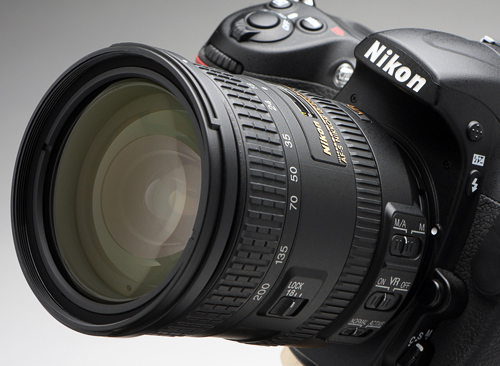
AF-S DX Nikkor 18-200mm f/3.5-5.6G ED VR II Review
Peter Burian tests Nikon’s latest multipurpose lens with some valuable benefits over the previous model

One of the best selling Nikon lenses, the original 18-200mm VR model was a very competent performer but it has been replaced with a newer zoom that offers several benefits. The latest incarnation includes the best of its predecessor but gains improved Super Integrated Coating for better flare control, and features to prevent zoom creep. As a bonus, the diaphragm is equipped with more blades allowing for a circular aperture at many f/stops. This aspect allows the lens to render out-of-focus highlights as circular for a more pleasing “bokeh”.

The latest Nikkor 18-200mm lens is a fine performer capable of producing excellent image quality. Thanks to its new features, this model is even more desirable than its highly-rated predecessor. (D300; f/22; 20mm; Hoya Pro 1 Digital polarizer; Webster's Falls, Hamilton, ON) ©2010 Peter K. Burian
While this “all-purpose” zoom may be ideal for families who simply want nice pics, it’s suitable for more serious photographers as well. As the price (about $750 in the US) should suggest, this is a premium-grade 27-300mm equivalent lens. The most expensive in its category, the Nikon model is also one of the largest/heaviest. That’s understandable because of the solid construction, two Extra Low Dispersion (ED) plus three aspherical elements for superior image quality, a remarkably effective image stabilizer plus very fast ultrasonic Silent Wave focus motor. Read the rest of this entry »
Canon Powershot G11 Digital Camera: Field Test Report
Posted on December 28th, 2009 by Peter K. Burian | 23 Comments
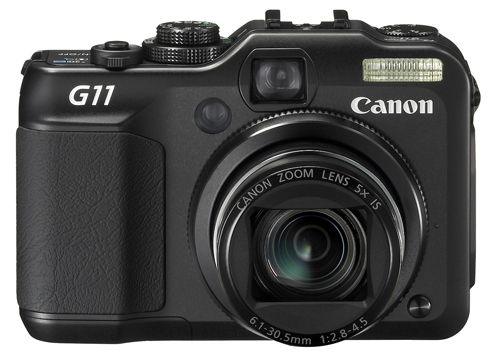
Peter Burian tests this premium-grade camera with 10MP resolution to determine how it compares to the very popular G10

One of the top rated digicams on the market, the 14.7 megapixel PowerShot G10 was recently replaced by the G11, with lower resolution said to provide superior image quality. The G10 was definitely an ideal second camera for serious photographers. In fact, this is the one that many of the pros carried when we went out for dinners while working at a week-long photo seminar in Dubai. (Also see Jack Neubart’s Canon PowerShot G10 Review here at Photocrati.com)
After testing the G10, I fell in love with that camera and bought one for my own use. While it received rave reviews about its conventional controls and low ISO quality, most test reports complained about its high ISO performance.

The 14.7 megapixel G10 was a highly-rated camera and produced fabulous images at low ISO but the G11 is even more desirable in some aspects. While resolution is lower at 10 MP, most reviewers agree that this is plenty for a digicam with built-in lens. (G11; ISO 100; f/8; 1/40 sec.)
In my own review for a Canadian magazine, I made the following comment about the G10: By ISO 800, images made in low light are still very sharp but very grainy although that’s not a problem in 5×7″ prints. At higher ISO, JPEG quality really suffers due to speckling and some smearing of fine detail by Noise Reduction processing. At ISO 800+, slightly better results are possible with Raw capture since Noise Reduction and Sharpening can be set to the optimal level in the converter software.
Most technical experts indicated that the problem was caused by the excessively small pixels (photosites). Apparently the engineers at Canon agreed since the company responded by replacing the G10 with the G11, with substantially lower 10 megapixel resolution provided by a new High Sensitivity sensor. That step made sense of course, since it allowed for larger photosites – with greater light gathering ability – for superior results at high ISO. Read the rest of this entry »
Leica M9 Digital Camera Review: Field Test Report
Posted on December 21st, 2009 by Jack Neubart | 9 Comments
Jack Neubart takes a step back in time to test this century’s classic manual-focusing, full-frame 18 MP CCD interchangeable-lens camera for the ages (along with the Summilux-M 21 mm f/1.4 ASPH).

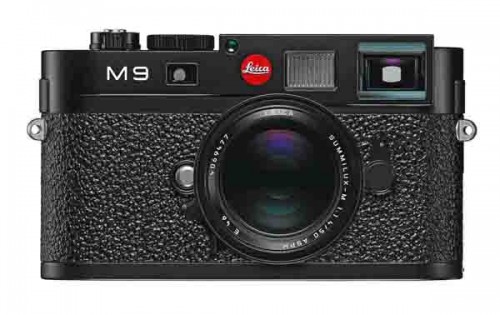
Leica M9 (front). A ruggedly built, Euro-styled digital rangefinder in which quality, performance, and price go hand in hand. Photo courtesy Leica.
It has been a very long time since I last worked with a rangefinder camera. And likely just as long since I last had the distinct pleasure of working with a Leica, although, as I recall, that was an SLR. The one thing that did stand out in my mind was how crisp the images were that came out of the Leica lenses I used.
Given that digital is, in a sense, a more complex image-forming process involving any number of variables mediating from the moment of capture on an imaging sensor and in-camera processing until the final image springs to life, I’m not sure that we’ll ever see quite the same quality, regardless of the lens or camera, or sensor. And yet we as photographers still manage to evolve our art with the technology and find ways to take that technology to new levels of creativity and bring new heights of awareness to every moment and scene we capture with our cameras.
The Leica M9 brings to mind my very first camera, the one that my dad bought me when I was a wee lad, and which he wouldn’t let me use for some years, afraid I’d break it (okay, I eventually did—but it wasn’t my fault, dad, I swear). So I bided my time and when the New York World’s Fair of 1964/65 rolled round, I finally got the chance to take the camera out on my own.
I loved that 35mm camera—a Neoca (Japanese top to bottom). It was no Leica by any stretch of the imagination. Didn’t even have a light meter inside. But it was a rangefinder. And what I remember about that rangefinder is that I was never entirely comfortable using it—I just didn’t feel it gave me the speed I needed or the certainty. And that’s still how I feel about rangefinder focusing. (However, I’m certain that many of you may feel just the opposite and would take a rangefinder over autofocusing or any other type of focusing any day of the week.)
And that brings us full circle to the M9, a full-frame, 18MP CCD digital camera featuring coincident-image rangefinder focusing—with the added benefit of interchangeable Leica lenses. Read the rest of this entry »
Phase One Capture One 5 Pro Review
Posted on December 6th, 2009 by Peter K. Burian | 3 Comments
Peter Burian reviews this workflow software with a vast range of advanced tools for enhancing RAW photos

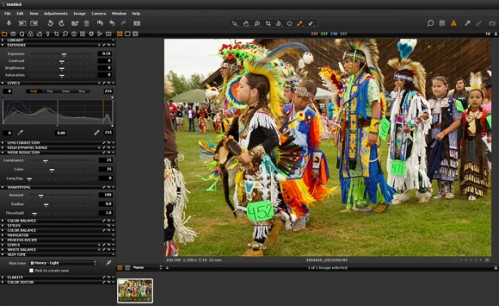
Better known for its medium format cameras and digital backs, Phase One –based in Copenhagen, Denmark with offices in New York – is also a software developer. The company’s powerful Capture One program has been available for several years, and was recently upgraded to version 5 with additional tools for even greater versatility. Capture One is described as a workflow package since it offers a full suite of options: control over a tethered camera, image importing, editing and final output. Because it would be impossible to review all aspects in less than 5000 words, I decided to test my own favorite feature of Capture One Pro 5: its RAW file enhancing and conversion capabilities.
Primary Features
Do note that there are two versions of the Phase One 5, Standard and Pro. (For full specifics about the differences, see http://www.phaseone.com/comparison .) Since 5 Pro offers far more editing tools – including some that are unique – I decided to try this more impressive program. Although I worked only on RAW files produced by an EOS 7D and Nikon D700, Capture One supports the RAW formats of all brands of cameras. Also, some of the software’s editing tools can be applied to JPEG and TIFF files if desired, for making non-destructive adjustments. (In the latter respect, Capture One is similar to software such as Lightroom and Aperture.) Read the rest of this entry »
Pentax K-7 Digital SLR Camera: Field Test Report
Posted on November 29th, 2009 by Peter K. Burian | 11 Comments
Peter Burian tests this rugged, well-sealed 14.5MP camera with pro caliber versatility and extras such as Movie mode and in-camera HDR

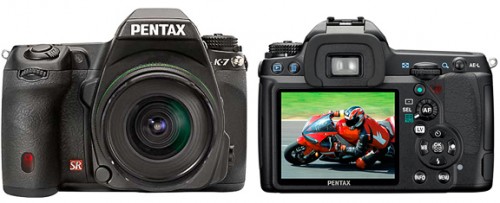
The flagship of the Pentax DLSR series, the K-7 is an unusually rugged semi-professional 14.5 MP camera that’s built like a tank: with a splash-proof magnesium alloy body over a stainless steel chassis. While the 14.5 megapixel K20D is less pricey, the K-7 is even more desirable. This newer model retains all of the K20D’s best features but provides significant benefits: faster (5.2 fps) drive speed, larger 3″ LCD with 920,000 dot resolution, a viewfinder with 100% coverage, plus upgrades for the sensor, processor, autofocus system, built-in image stabilizer and evaluative metering (now with 77 zones). More importantly, the K-7 offers some entirely new functions, including HD Movie mode. Read the rest of this entry »
Pentax K-x Digital SLR Review: Field Test Report
Posted on November 16th, 2009 by Jack Neubart | 54 Comments
Jack Neubart gets a taste of a sweet compact 12.4 MP CMOS APS-C DSLR with a suite of features.

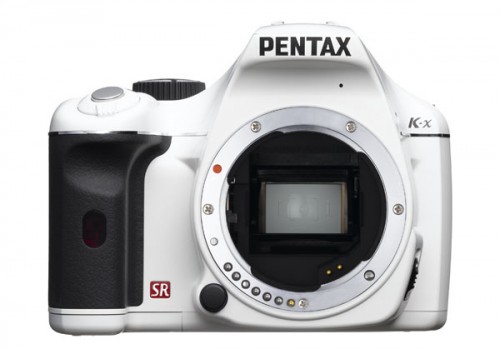
Pentax K-x body, white version. Photo courtesy of Pentax.
I approach each new camera with a degree of skepticism. Unlike many out there, I’m not as easily swayed by all the media hype and promotional gobbledygook. I’m from Brooklyn and we need to see that something actually works. So when the Pentax K-x arrived, I looked at it, pleased that they sent me the “white” version, only because it reminded me of the Imperial Storm Troopers from Star Wars (would have been a great fit). I unpacked everything, mated the lens to the K-x body, installed the lithium batteries that came in the box, then added my own SDHC card—none included (also takes standard SD—but why hamper the machine out of the gate!). And I started to play with it.
Hmm, not bad, I thought. But let’s see how it performs in the real world. So, intrepid explorer that I am, I ventured outside. It may not be a tropical rain forest, but it is an urban jungle out there rife with photographic opportunities. Read the rest of this entry »
Panasonic Lumix DMC-GH1 Review: Field Test Report
Posted on November 15th, 2009 by Peter K. Burian | 2 Comments
With its HD movie mode, articulating LCD and ultra high resolution viewfinder, the GH1 may be the most desirable Micro Four-Thirds camera

The first manufacturer to develop a Micro Four Thirds camera, Panasonic now markets three distinct models. These include the original DMC-G1, the pocket-size DMC-GF1, and the DMC-GH1 which benefits from the best features of the other models. These 12 megapixel cameras are all smaller/slimmer than DSLRs because they’re not equipped with a reflex mirror or a pentaprism. They also accept smaller lenses but employ a much larger sensor than most digicams with built-in lenses. That allows for much larger pixels for “cleaner” images – with a less “grainy” effect – at ISO 400 and above. Read the rest of this entry »
Nikon D300S Digital SLR Camera Review: Field Test Report
Posted on November 9th, 2009 by Jack Neubart | 3 Comments
Egad and gadzooks! It’s time for Jack Neubart’s Halloween review, where he ponders life, the universe, and, most importantly, whether the added features (notably, movies & dual flash cards) mean it’s time to upgrade from the D300 to the D300S.

Nikon D300S--front of camera. The Nikon D300S is a solidly built 12.3 MP CMOS DSLR that exhibits solid performance. It’s not revolutionary, but is definitely a step up the ladder, compared to the original D300. Photo courtesy Nikon.
I’ve been very happy with my Nikon D300. I’m certainly glad I didn’t wait for the next iteration to come out because I’ve made good use of this camera on two continents. Three, if you count Brooklyn, NY (we like to think of ourselves as more than simply a borough of New York City). Anyway, I approached a review of the next-gen D300, the D300S, with some degree of trepidation. I’m obviously not going to hate the camera, unless they somehow managed to mess up a good thing. And if I love it, then I have to consider buying it to replace a body that still has that fresh camera smell, and for which I paid good money (is money ever bad?).
Before continuing, I should note that you’ve no doubt read my friend and colleague’s report on the D300—Peter Burian was quite thorough. (If you haven’t, check it out here.) But this is where I give you my take on the camera, and go into specific differences between new and old.
One thing I noticed is that the manual for the D300 is actually 18 pages longer than that for the new D300S. As a D300 owner, I gloated. Then I also noted that the D300S Quick Guide has nearly twice as many pages—now I’m starting to feel cheated. What could explain these odd discrepancies? Well, I wasn’t about to dig through each booklet page by page, so let’s just see what pops up as we continue to explore, compare and contrast.
First Light: Canon EOS 7D
Posted on November 5th, 2009 by Joe Decker | 8 Comments
I’ve just started experimenting with the new Canon EOS 7D, which is an interesting beast–an APS 1.6x crop camera with 18 megapixels. Many folks, some of whom don’t appear to have used the camera, have criticized this camera as going too far along the megapixel path at the expense of ISO. To me, the “right” trade-off between those two features depends a lot on the specific job you’re doing. One of the things that interests me about the 7D is that it can serve as a lightweight backup for shooting birds and for occasional wildlife work.
For that purpose, I want good high-ISO performance (but I may not need world-class). I also want a lot of cropably-delicious little pixels–for anything else I’ll do with the camera, I’ll have a tripod.
I don’t think of the 7D (as some have suggested) as a “bad upgrade to the 5D Mark II”, I think that misses the point of this camera entirely. I think of it sort of as a “1D lite” the way that the 5D Mark II is sort of a “1Ds lite”. Of course, I have yet to discover if the 7D lives up to that standard, but I have a few good first impressions.
First, let me share with you a few badly-controlled handheld shots from my living room. Before you go look, let me apologize that the 1600 image isn’t pin-sharp because of camera movement, you should be able to get a sense of the noise characteristics despite these flaws. Read the rest of this entry »
TimeLapser app for iPhone
Posted on November 5th, 2009 by Steve Buchanan Photography | 2 Comments
One thing that many buyers of commercial photography like to see are behind the scenes videos of a shoot. It allows them to get a sense of how you like to work and what kind of shoot you might run if they were to hire you. Even for photographers working in the retail and personal fields, behind the scenes video can be a great marketing tool, showing potential clients and customers what their shoot might be like.
Of course, like photography, productions vary widely. You can shoot a scripted narrative with voice overs and scores. You can shoot a time lapse of the shoot and simply post that. The latter is certainly the easiest to shoot, and the TimeLapser app is designed to make that easy.
TimeLapser uses the built in camera to shoot individual frames, at a user-determined rate and resolution, then stitches those images together into a .mov file (at a user determined frame rate). At its heart, it’s basically an intervalometer that will combine the individual files together for you. Read the rest of this entry »
Sunrise & Set Pro for iPhone/iPod Touch
Posted on October 28th, 2009 by Steve Buchanan Photography | No Comments
Like many in this industry, I started as an assistant to other photographers. One cold and wet afternoon while cleaning the cases of one of my clients I came across a curious set of plastic laminated cards with the word “Sundicator” printed on them. Being the complete geek that I was (am,) I recognized the terms Azimuth and Inclination and figured that these cards were a way of estimating where in the sky the sun would be at a particular time and place. Each card was specific to a range of latitudes on the globe. In order to use the set properly you needed the correct card for your latitude and a compass. It’s worth noting that this photographer had lost the card for our home latitude.
Jump ahead 15 or so years and you have the age of gps and hand held computing. Hence the iPhone app Sunrise and Set Pro. This wonderful little app will read your current gps location and tell you the Azimuth (heading) in inclination (angle above horizon) of the sun for any given time. It will also give you sunrise and sunset times for that location on any given day. The app automatically computes daylight savings time issues which is great because I can never remember whether to add or subtract and hour. And it will also allow you to save custom locations for later review. This is a great option for location scouting. With saved locations you can easily change dates and times of shoots from home and know what the sun will be doing before arriving on location. Read the rest of this entry »
Traveling with Equipment
Posted on October 27th, 2009 by Fred Troilo | No Comments
One requirement of being a corporate photographer is travel. Fortunately most of my travel is fairly local, or at least what I consider local, Philadelphia to Washington DC and on occasion, New York. I tend to be in DC a couple times a month, sometimes a couple times a week. Most of my trips are by train so I try to travel light, and by light I mean two Nikon bodies, four lenses, three speed lights, Pocket Wizards and batteries, so not really light. I needed to find an easier way to carry my gear. Read the rest of this entry »
Sony Alpha A850 Digital SLR Review: Field Test Report
Posted on October 25th, 2009 by Peter K. Burian | 17 Comments
The World’s Most Affordable Full-Frame DSLR

Boasting the highest resolution available in a 35mm size DSLR, the latest Sony camera is also the most affordable full-frame model on the market. Priced to sell at about $700 less than the Sony A900, the Nikon D700 and the Canon EOS 5D Mk II, the A850 is a downright bargain (from Amazon Sony Alpha DSLRA850 24.6MP Digital SLR Camera (Body Only); from B&H Photo).
In spite of the moderate price, it’s identical to the A900 in most aspects, including the 24×36mm CMOS sensor with 24.6 million effective pixels. Each light-sensitive dot is quite large: 5.9 microns squared. In addition to excellent light gathering ability, analog-to-digital conversion and noise reduction processing— right on the sensor—combine to provide optimal image quality.

Because the A850 employs a sensor that's the same size as a 35mm film frame, there's no field of view crop. Hence, even a 24mm focal length includes a very wide portion of any scene. The 24.6 MP CMOS chip provides superlative resolution at commonly used ISO's, making this camera an ideal choice when huge prints are required. (Carl Zeiss 24-70mm zoom at 24mm) ©2009 Peter K. Burian
DSLRemote for iPhone and iPod touch
Posted on October 21st, 2009 by Steve Buchanan Photography | No Comments
In order to be successful in this business you need a lot of tools at your disposal. I mean not only physical tools like gear and software, but also intangible tools like a positive attitude and a penchant for keeping clients happy. Also, the ability to keep clients in awe of you is always a big help. I’ve stated here many times that I’m not a gear head. I’m perfectly willing to spend money on necessary gear. But my bar for what I deem necessary is very high. It’s a rare day when I’ll go buy something just because I think it’s cool or fun. Last week I made an exception to my ‘not unless it makes my work better” rule and purchased DSLRemote Pro for my iPhone. Read the rest of this entry »
Nikon D5000 Digital SLR Review: Field Test Report
Posted on October 18th, 2009 by Peter K. Burian | 2 Comments
Peter Burian tests this affordable 12.3 MP DSLR with variable-angle LCD, D-Movie mode and sophisticated Nikon technology

Nikon’s most affordable enthusiast-level DSLR—the 12.3 megapixel D5000—is positioned between the D3000 and the D90 and offers the best of both worlds. The D5000 is as easy to use as the entry-level camera and provides even more Scene modes but it employs powerful technology and advanced features developed for the larger prosumer-grade model.That includes D-Movie mode in Live View, although the LCD screen is slightly smaller and provides lower resolution when compared to the D90. Read the rest of this entry »
Perfect Photo…
Posted on October 14th, 2009 by Steve Buchanan Photography | 1 Comment
From your iPhone? Well maybe not perfect, but certainly better than what you’re able to do with the stock camera. Last week I reviewed the Best Camera app and one of my complaints about the preset filters was the fact that the user can not edit those filters. The Perfect Photo app does allow more fine tuned control over the image.
Like most camera based apps you can either shoot a new picture right from the app or load one from your saved images. From there you’ve got the ability to edit several aspects of the image.
You can…
- rotate/flip
- crop
- adjust alignment (i.e. fix crooked images)
- adjust brightness/contrast
- adjust gamma
- adjust exposure
- increase shadow detail
- increase highlight detail
- adjust levels
- adjust hue, saturation and lightness
- adjust color balance
- adjust color temperature
- sharpen
- remove noise
There are also several preset effects: Read the rest of this entry »
Sony A500 and A550 Digital SLR Review: Field Test Report
Posted on October 12th, 2009 by Peter K. Burian | 43 Comments
Peter Burian tests this affordable prosumer-grade duo with some digicam-style features for novices
A very prolific manufacturer, Sony markets more DSLR models than any other company. The new A500 (Amazon: Sony Alpha DSLRA500 12.3MP Digital SLR Camera (Body only); B&H: Sony A500) and A550 (Amazon: Sony Alpha DSLR-A550 14.2MP Digital SLR Camera (Body Only); B&H: Sony A550) target photo enthusiasts and they’re identical except for a few aspects. The A550 boasts a 14.2 megapixel CMOS sensor and an ultra-high resolution LCD while the more affordable A500 is a 12.3 megapixel camera with a more typical LCD. While they will satisfy experienced photographers, with their digicam-style features these cameras should be equally attractive to novices.


These DSLRs retain the best of the earlier A350 including live view with remarkably fast autofocus. Their most notable new benefits include much faster continuous drive speed, face detection plus Smile Shutter technology—plus a second, new live view mode. Read the rest of this entry »
Q and A: What are the best, affordable LCD monitors for photographers?
Posted on October 9th, 2009 by Peter K. Burian | 1 Comment
Question
I appreciate your test reports on Photocrati.com and want to ask for a recommendation about a computer monitor. What are the best LCD monitors for photographers and what is available at a reasonable price? I don’t want to pay thousands of dollars. S.R.
Answer
Most reviewers agree that the Eizo Color Edge CG series is among the very best in LCD monitors for digital photographers and graphic arts professionals. Some of the CG models do cost thousands, but the 22-in CH222W (B&H: CH222W), (Amazon 22IN 1650X1050 Coloredge Blk Dig/alog) is more affordable and ships with a hood to block stray light. This model provides 1680 x 1050 resolution, a very wide color gamut (97% sRGB , and 92% Adobe RGB coverage) and other pro-grade features such as dual DVI interface and ColorNavigator calibration software. Brightness is 200 cd/m2 (more than adequate) and the contrast ratio is 800:1.
Many of us want to spend less, making two other monitors more popular. Read the rest of this entry »